The Finnish Faktabaari EDU NGO has published a draft English version of total of 286 task cards for teaching AI literacy, covering early education through higher education. The materials have been developed by Jukka Lehtoranta with the help of Kari Kivinen.
The cards are organised by level of education and, within each level, by subject. Each card is based on the principle of AI as supporting tool in which AI can be used to support human thinking, learning and action, not as a source of information or a substitute for decision making.
The task cards are also linked to Finnish curricula of different levels of education.
AI as supportive tool
When it comes to AI-assisted thinking, humans retain agency: they steer the AI, critically evaluate its outputs, and make informed decisions themselves. AI is a tool whose limitations and potential are understood.
Responsible AI use requires knowledge, skills and attitudes that enable informed, safe, critical and ethical use of AI systems in learning, work and participation in society. It encourages people to use AI to support human thinking and action, and to assess the benefits and risks of AI in each situation.
Supporting AI approach requires:
an understanding of how AI works and its limitations
the ability to use and apply AI purposefully
the ability to critically evaluate AI outputs, biases and reliability; and
the ability to use AI ethically, responsibly and with respect for human agency.
The supporting AI approach is structured around four key questions:
What is AI, how does it work, and what are its basic components, such as language models, data, and algorithms?
How can AI be used safely, responsibly and ethically? ¨
What are the risks of using AI, and what are its potential societal and ecological impacts?
Why must the reliability of AI-generated content always be critically evaluated?
AI competence descriptions
The task cards are based on the AI competence descriptions for learners developed by the Faktabaari team. These descriptions cover the entire educational journey, from early childhood education and care and pre-primary education to basic education, general upper secondary education, vocational education and training, and higher education. These descriptions will be updated based on feedback from the pilot project and comments received. The descriptions are based on the OECD and European Union AILit Framework (2026) and DigComp 3.0.
You can download the PDF version of task cards here!
You can download the AI competence descriptions for learners here!
Feedback
We are aware that the English translation is not perfect and will revise it when the final version is published later on this year. Therefore, all comments and corrections are more than welcome! (Kari (@) Kivinen.net).
Disclaimer
AI-assisted tools were used to prepare this guide for ideation, information retrieval, language editing and translation. The authors are responsible for selecting, verifying and finalising the content. All AI-generated or AI-translated material has been reviewed by the authors.
The descriptions of pupils’ AI skills have been drawn up as part of the ‘From Artificial Intelligence to Supportive Intelligence’ project, which is funded by the Alfred Kordelin Foundation for the years 2025–2026
In Finland, media and information literacy (MIL) is seen as civic competence: important to every citizen from an early age. This skill is promoted not only by schools, but also by libraries, non-governmental organisations (NGOs) and institutions that promote lifelong learning.
The media and information is already part of early childhood education and care.
According to the National Core Curriculum for Early Childhood Education and Care (2022): “Digitalisation is part of the society in which the child grows up. Digital competence is needed in interaction between people, participation in society and learning.
Strengthening digital competence promotes children’s educational equality. The task of curricula is, together with the home, to support the child’s understanding of digitalisation.
The role of digitalisation in everyday life is explored and observed with the children. Digital tools, applications and environments are used in documentation, play, interaction, games, exploration, physical activity and artistic experience and production.
Possibilities for practising, experimenting and personally and collaboratively producing content with the help of digital tools promote creative thinking, teamwork skills and multiliteracy in children. The personnel guide children in versatile, responsible, and safe use of digital environments.”
Multiliteracy Multiliteracy is a key concept in Finnish curricula, from early education to basic education. Media education is introduced as part of transversal competencies, which include multiliteracy, self-care, and other everyday skills. These transversal competences also include cultural competence, interaction skills, and digital competence, all of which are needed in an increasingly diverse world.
Multiliteracy is needed in the everyday lives of children and families, interaction, and participation in the society. Multiliteracy promotes children’s equality in education.
Multiliteracy is a core competence from the viewpoint of interaction and understanding culturally diverse messages and the surrounding world.
According to curriculum, multiliteracy refers to skills in interpreting and producing various types of messages. Multiliteracy is founded on a broad conception of text according to which different texts may be, among others, written, spoken, audiovisual or digital. Multiliteracy comprises different types of literacy, such as visual literacy, numerical literacy, media literacy and basic literacy. It is closely connected to thinking and learning skills. Children practise naming things and objects and learn different concepts. Children are encouraged to explore, use, and produce messages in different environments, including digital ones. In order to develop their multiliteracy, children need an example provided by an adult and a rich textual environment, culture produced by children and cultural services appropriate for children
Media and Information literacy competence
Media literacy is the skill to use, understand and evaluate media contents and the skill to produce them. In addition, media literacy includes the skill to operate in media environments.
The three main areas of media literacy are:
Interpretation and evaluation of media
Media production
Operating in media environments
You can find a set of interesting MIL competencies and learning outcome descriptions ranging from early childhood education and care to basic teaching at this link!
Digital competences
The Digital competence and ICT competence as a whole consist of four main areas:
Interaction.
Practical skills and personal production
Security and responsibility
Information management and inquiry-based and creative work
You can view the descriptions of digital competence and ICT competence at this link.
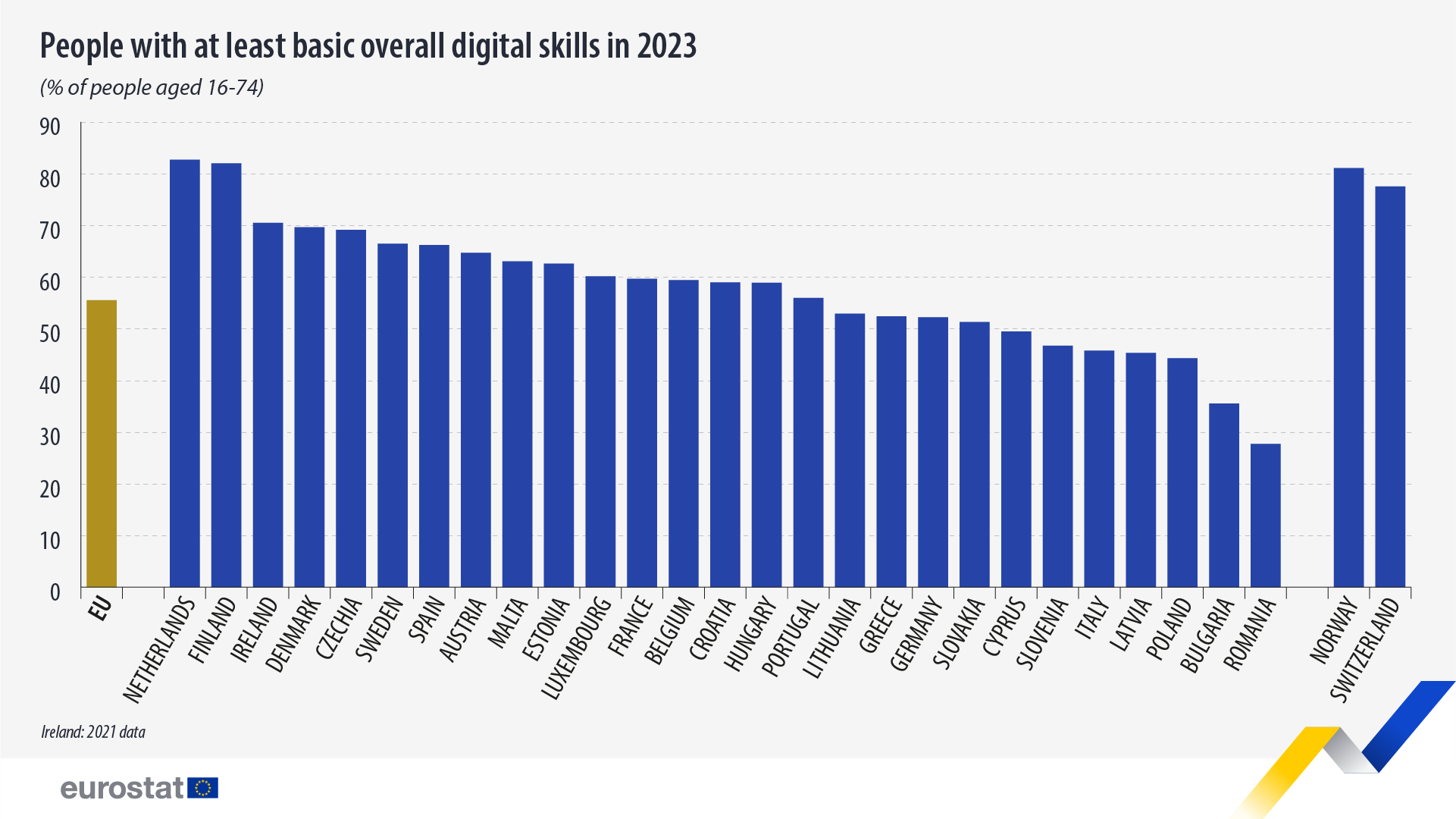
It is not a big surprise, that according to the Eurostat, Finnish people have good basic overall skills compared to other countries.
Tackling disinformation
According to Finnish National Audiovisual Institute (KAVI), Finnish students study famous historical propaganda campaigns, learn about advertising, and discover how statistics can be used to mislead people. They also learn to distinguish between disinformation, which is the deliberate distribution of false information, and misinformation, which is the unintentional distribution of false information.
The ability to tackle online mis/disinformation, is especially important for us in Finland. This is due to our specific location next to Russia. Information influencing is a real risk for our democracy in our media landscape. Another challenge Finland needs to tackle is maintaining a high level of traditional reading ability. The number of adult readers is declining, which also affects younger generations.
Leo Pekkala, the deputy director of the (KAVI), has said “Media literacy by itself is not the end goal. Media literacy is like learning a language, so you have both the technical skill to use media and the ability to understand it.”
Media literacy enables people to contribute to a strong, durable and flexible society that is better able to adapt to and overcome unexpected situations, and to safeguard our democracy.
All graphics in this article are made with Napkin.ai
In recent years, AI technology has advanced so rapidly that it has been difficult for education authorities to keep up with developments and provide updated guidance and in-service training for teachers. Teachers have therefore found themselves in a difficult position: How should they teach students to use AI technologies safely and responsibly when schools do not have clear guidelines on which software and services are safe to use and how to teach new skills within a partly outdated curriculum?
The relationship between education and AI is changing rapidly. AI developments and new easy-to-use AI systems – in particular generative AI – have already had a significant impact on teaching and learning.
This article is an attempt to provide some basic information on the way that Generative AI works.
Generative AI
Generative AI (GenAI) uses Large Language Models (LLMs) and neural networks. It is a branch of AI that creates new content rather than simply analysing or classifying existing content or data.
The following definition of generative AI is derived from the Finnish National Agency for Education’s version of the draft statement [i]:
“While natural language is a common way to interact with GenAI, it is not the only way to interact with GenAI; inputs can also be, for example, code or images. GenAI generates new content based on a model created from training materials. Large language models can be generated either from public content on the Internet or from more limited, closed data sets.
In addition to large language models, generative AI can also be based on other models and techniques optimised for specific purposes, such as creating new music, videos or images. For example, so-called diffusion models focus on the creation and manipulation of images and sound”.
Large language models
Large language models are trained on huge amounts of data. This data can include books, articles, code and other forms of written communication, as well as images and graphics.
Continuous data collection is made possible by data collectors – bots that collect data from the web. Nowadays, website operators can also opt out of data collection. It should be noted that data collection can also lead to the accumulation of inaccurate, discriminatory and biased information in training materials.
Language models use the collected data to learn the relationships between words and phrases and the meanings of different types of text. This enables them to perform a variety of tasks, such as translating languages, producing creative content and answering questions. As AI technology develops, these models will become more sophisticated and offer opportunities for a wide range of applications.
Chatbots and virtual assistants use language models to provide users with responses to their input. Content creators use these models to produce articles, blog posts and marketing materials. In education, for example, they help teachers to create teaching materials and exercises.
Language models are built using neural networks, particularly the so-called transformer architecture. It is a deep learning method that provides an efficient way of processing e.g. sentences, text fragments and contexts. To make this possible, the text needs to be transformed into a numerical format that allows complex computations. This is called tokenisation.
Data points and tokens
Tokenisation is the process of converting text or images into a numerical format that computers can process. It involves breaking text into smaller pieces called tokens, which can be words, phrases or even single characters. Each token is given a numerical representation (embedding) that reflects its meaning in context. This method allows mathematical operations between sequences of words (tokens), for example by comparing their similarity. Contextualisation, which considers the occurrence of a sequence of words in the surrounding text, is crucial for the model to understand the meaning of a sentence or paragraph.
By breaking down text into tokens, models can better understand the underlying structure and meaning of the language.
Tokenisation splits the text into parts. Numerical representation (embedding) turns words into numbers (vectors). Contextualisation changes these vectors to reflect the meaning of the word in the context in which it occurs. This allows the computer to “understand” that the same word can mean different things in different sentences. The vectors can also be used to calculate the similarity of words: vectors that are close together mean similar things.
A data point represents a single observation or event in a data set. A token is a smaller, indivisible unit of data extracted from a data point. In the sentence “The cat sat on the mat”, each word (“the”, “cat”, “sat”, “on”, “the”, “mat”) would be considered a token. However, tokenisation can be more nuanced. For example, the word “running” could be broken down into subword tokens such as “run” and “ing”. This approach, known as subword tokenisation, helps models deal with rare words or words that are not in their vocabulary.
Data points and tokens are the basic data units used to train and operate AI systems.
For example, a data point can be thought of as a complete recipe that lists all the ingredients, while a token can be thought of as a single ingredient in that recipe.
AI models work by processing many data points, each containing multiple tokens. The model analyses the relationships between these tokens to learn patterns and make predictions.
Tokens, data points and models are used to produce output. For example, GenAI tools can be asked to answer a question in the form of a text prompt that serves as input to a statistical model. The statistical model converts this prompt into numbers. The model then performs computations to predict the output based on statistical associations.
The best-known generative AI service is called ChatGPT, where GPT stands for “Generative Pre-trained Transformer”, which refers to the way ChatGPT is trained to process and understand large amounts of text data. This pre-training enables ChatGPT to produce human-like text in response to a variety of questions and requests. The model is a “transformer” because it uses a powerful neural network architecture.
What material has been used to train language models?
According to OpenAI [iii], the models used by the current ChatGPT have been developed using three primary sources of information:
Information that is publicly available on the Internet,
Information that we partner with third parties to access, and
Information that our users or human trainers and researchers provide or generate.
Unfortunately, however, these massive data sets often lack clear information about what they contain and where they come from [iv]. AI companies generally do not disclose what data they have used to train their models. One reason is that they want to protect their own competitive advantage. Another reason is that because data sets are bundled, packaged and distributed in a complex and opaque way, they are unlikely to know where all the data comes from.
The data used to train AI models is also heavily Western. More than 90% of the data sets analysed by the researchers came from Europe and North America, and less than 4% from Africa [v]. The dominance of English in the training data is partly explained by the fact that the Internet is still more than 90% English-speaking, and there are still many places on the planet where Internet connectivity is very poor or non-existent. This bias in the training material also has an impact on AI’s performance and should always be viewed with a healthy dose of scepticism.
Holmes and Tuomi [vi] stress that the role of humans in the functioning of AI systems should not be forgotten. Humans collect or curate the training data (e.g. images or text) used by AI, and humans write the algorithms or programme code underlying AI technologies and decide what to do with it.
Pre-training and neural network
During pre-training, the algorithms process a huge number of data points and tokens based on a large data mass.
A key element of generative AI is a neural network that mimics the general principles of neuronal function in the animal brain. A neural network is composed of interconnected nodes arranged in layers.
Input layer – receives and processes the raw data (e.g. an image, text or numerical values).
Hidden layers – perform complex computations on the input data, extracting features and identifying patterns.
Output layer – produces the network’s output, which can take various forms.
During training, the AI model learns the relationships and patterns within the data by adjusting the strength of the connections between nodes, called weights. The training process involves continually adjusting these weights to minimise errors and improve the model’s ability to predict or generate content. Optimisation algorithms are commonly used to adjust the weights, the most important of which is currently the “GTP”, after which ChatGPT is named.
Once the AI model has been sufficiently trained, it is able to generate content based on the given input. Based on the patterns and relationships it learns from the training data, the model produces a consistent and contextually appropriate output for the training data that was used.
Generative AI utilises deep learning models, which are part of machine learning models. Machine learning refers to the ability of a system to learn autonomously from the data it is given, without a human determining all its functions. Deep learning allows AI models to learn to recognise patterns and connections in massive amounts of data, such as images or text. They can then generate new, similar data that replicates the features present in the original data. This differs from traditional rule-based AI systems, which follow predefined rules and are unable to learn or improve over time.
Training AI models requires huge amounts of data, high-performance technology and financial resources. Only very large companies can develop these models. Fortunately, these models can be used for many different purposes.
Although generative models are powerful, they also have limitations. For example, they can produce erroneous conclusions and biased content.
Fine-tuning
Fine-tuning aims to adapt a foundational model to a specific task. The model is trained on a smaller and limited set of data related to the desired application. Fine-tuning improves the performance of the model in the given task domain and makes the model more cost-effective to use.
Fine-tuning enables the development of GenAI applications for a wide range of purposes. Indeed, dozens of new AI applications are appearing on the market every week for a wide variety of purposes.
Input, prompt or feed
An Input is a command given by the user to the AI. It can be text, sound, image or programme code. Based on the input, the AI produces the desired result. The more precise and detailed the input, the better the result.
It is the inputs that influence the outcome produced by the generative AI. Skilful design of inputs is therefore an important skill to practice. Fortunately, there are many instructions and examples available on the Internet, and many AI services also provide tools and example feeds. You can also ask AI services directly for advice on how to create a better feed. In most cases, it is not a good idea to settle for the first result, but to work on it further by asking the AI service to refine and improve the output.
The difference between generative AI services and search engines
It is very important to recognise that “traditional” search engines and generative AI software serve different needs and provide different services to their users. Search engines search for existing information, while GenAI services create new content.
Search engines use algorithms that analyse page content, number of links and other factors to determine the relevance and order of pages in search results. They search and organise data on the Internet based on the search terms entered by the user.
Search results are based on both the user’s previous searches and the recommendations of the search engine’s algorithm.
In most cases, the information seeker will receive thousands or even millions of direct links to data on the Internet. It is the user’s responsibility to choose the one that best suits their information needs. On the positive side, the user can directly assess the reliability of the information source. Unfortunately, search engines such as Google do not use transparent search logic, and organise and censor results based on the user’s profile. Paid or sponsored results often come first in search results, as search engines are driven by commercial interests.
More recently, GenAI services have started to propose a combination of these two different approaches. For example, Google Gemini (version 1.5 Flash) offers the possibility to “check” GenAI results with the Google search engine. This function can be found in the three-dot menu below the answer (“Check the answer carefully”).
If you use a “normal” search engine to find information on, say, Faktabaari, you will be presented with millions of very different results (Bing: over 15 million hits), including criticisms of Faktabaari. Asking ChatGPT’s online search function “What is Faktabaari” will return a short summary of Faktabaari. One may wonder why particular sentences are chosen and whether the ChatGPT summary gives a realistic and comprehensive picture of Faktabaari’s activities.
The operating mechanism of generative AI applications creates new content from large amounts of data. The user usually receives only one answer at a time, based on computed probabilities according to the process described above. On the other hand, the user can receive additional information by submitting finetuning questions and prompts and the results can be further processed and refined. Although the answer produced by the GenAI service often has a high degree of confidence, it may be incorrect. GenAI models do not understand the text they produce but are based on statistical models and training data. Therefore, their outputs may be incorrect or misleading. This highlights the need for source criticism when checking the outputs of GenAI services. So, for example, under the Gemini input field it says “Gemini can make mistakes, even when it comes to information about people, so it’s important to double-check its responses.”
[vi] Holmes, Wayne and Tuomi, Ilkka (2022) State of the art and practice in AI in education. Speciali Issue: Futures of artifical intelligence in education. European Journal of Education. Volume 57, Issue 4. https://onlinelibrary.wiley.com/doi/10.1111/ejed.12533
The use of AI services raises ethical and intellectual property concerns. In order for teachers and students to work confidently, critically and safely with new and emerging technologies, they should have basic knowledge and a common understanding of how GenAI can be used in education, without forgetting copyright issues.
Generative AI services can be used to create text, images, videos and music. However, there are many copyright uncertainties behind the creative outputs of these services. Rapid technological developments result in legislation lagging behind
Training large language models requires huge amounts of text, code, images and data, much of which may be protected by copyright. If such data is collected without the permission of the rightholder, there is a risk that someone’s copyright may be infringed.
The content of the material used to train the popular language models is currently opaque. The EU’s AI Act, which comes into force in 2026, will require future general-purpose AI systems to comply with EU copyright law and provide summaries of the content used to train the data. The near future will show how this will be implemented. As we do not yet know what information has been used to train AI models, it is difficult to assess potential copyright infringements.
The content of the material used to train the popular language models is, at least for the time being, obscure.
Many lawsuits
AI services can produce output that imitates or closely resembles a copyrighted work. Several artists and publishers have filed lawsuits accusing AI platforms of illegal copying and prohibiting the use of their works for data collection and education. The most high-profile of these lawsuits is the New York Times case against OpenAI. In its defence, OpenAI has issued an interesting response:
”Because copyright today covers virtually every sort of human expression – including blog posts, photographs, forum posts, scraps of software code, and government documents – it would be impossible to train today’s leading AI models without using copyrighted materials.”.”[i]
The decisions in these cases will shape and update copyright law and practice for years to come. It is still relatively unclear how we can prevent AI services from infringing copyright, and what sanctions should be applied and by whom.
The main issue for users of AI services is who owns the outputs of AI. Can traditional copyright apply to them, or are new solutions needed? Currently, copyright does not protect AI-generated works with little or no human input.
Preventing data collection
In particular, large publishers and media houses have begun to block the collection of copyrighted content on their websites. However, blocking data collection can reduce the site’s visibility in search engines and prevent legitimate search engines from indexing the site’s content.
According to Wired[ii], 88% of leading US news agencies block data collection. The Reuters Institute reported[iii] that in February 2024, nearly half (48%) of leading news sites in ten countries blocked OpenAI data collectors. This is something of a problem for GenAI users, as quality and up-to-date content is often excluded from training material. AI services have therefore started to license content from different content providers to ensure quality educational content. This positive trend is likely to increase in the near future.
Major publishers and media houses have started to block the collection of copyrighted content on their websites.
Copyright and education
Generative AI services may collect information on all input and prompts in their databases in order to train language models. The same can happen, for example, when students’ work is scanned by plagiarism checkers.
Particular care should be taken with sensitive data, which should not be fed into AI services under any circumstances. It is therefore crucial to choose AI tools that ensure security practices. For example, they should ensure that data from feeds is not stored or reused for further training purposes. It is also important to remember that most student work is copyrighted material. Education providers should therefore ensure that the AI tools they use comply with EU copyright laws.
Sensitive data should not, under any circumstances, be fed into an AI service.
EUIPO published an interactive infographic on ”Generative AI in Education – Understanding copyright implications” Educate your students about copyright. Explain that AI-generated content can still infringe on existing copyright if it reproduces copyrighted material. Teach proper citation skills and how to attribute and credit content generated by GenAI. Promote critical thinking to verify the accuracy of the GenAI outputs. Encourage students to create original works and use AI as a tool for inspiration, not to replace their own creativity. Create interactive lessons where students practice looking for, using, and citing AI-generated content properly.
Finnish Faktabaari will publish soon the AI Guide for Teachers. This article will be part of the new Guide.
Generative AI, capable of crafting eerily human-like text, images, and music, holds immense potential. But beneath its creative prowess lies a murky legal swamp: copyright. Training these models often involves vast troves of text, code, images and data – much of it potentially copyrighted, scraped from the internet without permission.
According to WIPO[1], “Generative AI has sparked intense discussions regarding potential copyright infringement by including protected works in training data and copyright protection for AI generated output.However, it is essential to recognize that IP questions related to generative AI are not limited to copyright.”
In this article, I focus nevertheless only on critical copyright questions concerning the GenAI data input and output:
The data input dilemma:
We don’t know what data AI models ingest, making it difficult to assess possible copyright infringement. Lawsuits are already flying, with artists and publishers challenging the use of their work in training. The most followed of these lawsuits is the New York Times case against Open AI. As a defense OpenAI has given an interesting answer[2]:
“Because copyright today covers virtually every sort of human expression – including blog posts, photographs, forum posts, scraps of software code, and government documents – it would be impossible to train today’s leading AI models without using copyrighted materials.”
There are technical solutions to prevent the scraping of copyrighted content from the web such as the robots.txt procedure. In the summer of 2023, OpenAI gave the possibility for media houses to use these technical solutions to prevent scraping. Therefore, news outlets are increasingly blocking AI crawlers, which has created new types of worries. According to Wired[3]
“New data shows that over 88 percent of top-ranked news outlets in the US now block web crawlers used by artificial intelligence companies to collect training data for chatbots and other AI projects. One sector of the news business is a glaring outlier, though: Right-wing media lags far behind their liberal counterparts when it comes to bot-blocking.”
This is not a very promising development from the unbiased content quality point of view.
Reuters Institute has reported[4] in February 2024, that the proportion of news websites that blocked OpenAI varied considerably by country, ranging from 79% in the USA to just 20% in Mexico and Poland. For Google, the figures ranged from 60% in Germany to 7% in Poland and Spain. In general, 48% of the most widely used news websites across ten countries were blocking OpenAI’s crawlers. A smaller number, 24%, were blocking Google’s AI crawler.
Legal gray areas
Though accessible globally, GenAI platforms operate within specific countries. While some copyright laws are internationally harmonized, each country ultimately retains its own legal framework. This creates and will continue to create grey areas regarding copyright, highlighting the need for further clarification shortly.
It is now discussed, what to do. Could existing copyright exceptions cover AI training? Would collective licensing schemes offer a solution? Should new frameworks be created?
Copyright challenges related to GenAi outputs
The outputs of GenAI tools are generated from simple prompts or can be used to assist people in their innovative, creative, branding, and other information and knowledge activities.
This inevitably raises various copyright-related questions. The most important one is: Who owns AI creativity? Can traditional copyright apply, or do we need new solutions?
Currently, only creative work done by humans enjoys copyright protection.
Creators are worried that AI-generated work might copy their style or ideas and take away their business. The new EU AI Act might require disclosure that the was made by AI as well as detailed listing of the original content used to train it. This would help protect creators and make things clearer for everyone.
While some IP offices have issued guidelines on the criteria for copyright protection of AI-generated outputs, some are also considering ways to use other intellectual property rights to protect such works.
It is still relatively unclear, how can we prevent AI from infringing copyrights, and what penalties should apply and by whom?
AI Act
EU’s AI Act has been in making quite a while. It is not yet finalised (situation 23.2.2024), but a general consensus has been found and the first actions have taken place.
The European AI Office was established in February 2024 within the Commission to oversee the AI Act’s enforcement and implementation with the member states. It aims to create an environment where AI technologies respect human dignity, rights, and trust.
It also should foster collaboration, innovation, and research in AI among various stakeholders.
According to AI Act copyright related principles, providers of General purpose AI (GPAI) models must adopt a policy of respecting EU copyright law, including an obligation to make publicly available a sufficiently detailed summary of the content used to train the GPAI model. Any use of copyright-protected content requires the authorization of the right holder unless relevant copyright exceptions and limitations apply. However, there are some exceptions and limitations that allow to use of copyrighted material e.g. for data mining, but only under specific conditions.
The AI Act regulation will only apply 24 months after it enters into force, (i.e. in the 2nd quarter of 2026 at the earliest).
Finding a way out
Unlocking AI’s potential hinges on addressing all these new legal, moral and ethical issues. A collaborative approach involving creators, developers, rights holders, policymakers, and researchers is crucial. We need:
Regulation and clear legal frameworks (such as AI Act): Defining fair use for AI training, establishing ownership of AI outputs, and addressing international complexities.
Transparency and accountability: Requiring AI services and AI users to disclose training data and copyrighted sources.
Collective licensing systems: Clarity on how to prevent or allow using copyrighted data in training.
Ethical considerations: Balancing innovation with respect for creators’ rights and the potential societal impact of AI-generated content.
Ignoring these challenges will stifle AI’s potential and create a breeding ground for legal battles. By fostering a transparent and responsible approach, we can ensure AI flourishes on a foundation of respect for intellectual property and creativity.
How do you tackle Misinformation, Disinformation, and Malinformation in the age of Artificial Intelligence, Social Media, and Hyper Partisanship?
What tools can be used to fight “Information Disorder”?
Why is Finland unique in this respect and how can you effectively teach digital & media literacy?
Join us as we travel to Spain for an illuminating conversation with Dr. Kari Kivinen, one of the leading global experts on Misinformation & Disinformation.
During the past 12 months I have had a pleasure to participate in several interesting projects to tackle disinformation and to promote digital literacy. You can find below a short information and links to these free-to-use materials.Have a look!
Facts4All MOOC – Schools tackling disinformation
The Facts4All Massive Open Online Course (MOOC) empowers primary and secondary teachers to develop and implement effective whole-school approaches to foster critical thinking and tackle online disinformation through intergenerational collaboration and community engagement. The course is targeted at primary and secondary school teachers of any subject.
Facts4All MOOC is available for free in the European Schoolnet Academy – which has also plenty of other interesting materials.
Digital Information Literacy Guideby Finnish FaktabaariEDU
Finnish fact-checking organisation Faktabaari has been working a long time with digital information literacy (DIL). FaktabaariEDU published a DIL-guide in September 2022.
Digital information literacy is a modern civic skill that underpins participation in democratic decision-making. Finland is renowned for its high literacy rate, and the teaching of multiple literacies has been integrated into current curricula from early childhood education onwards.
However, on digital platforms we all are confronted with a bewildering flood of information that they may not be able to filter out with the skills they have acquired in the school community and at home: claims about products by influencers, search results tailored by commercial algorithms, cleverly scripted propaganda and authorisations to track online behaviour or physical movement in urban space hidden behind countless ‘yes’ buttons. It is therefore important to strengthen the digital information literacy of all the web users, especially young people, in order to identify how we are being influenced online.
This guide is a collection of information and examples on how to enhance digital information literacy.
10 writers – 16 articles highlighting the different areas of digital civilization. Faktabaari has realized this publication as part of EDMO NORDIS project
DigComp 2.2.
The Digital Competence Framework for Citizen (DigComp) provides a common understanding of what digital competence is.
The integrated DigComp 2.2 framework provides more than 250 new examples of knowledge, skills and attitudes that help citizens engage confidently, critically and safely with digital technologies, and new and emerging ones such as systems driven by artificial intelligence (AI).
Final report of the European Commission expert group tackling disinformation and promoting digital literacy through education and training
The final report of the expert group brings together the main insights on tackling disinformation and promoting digital literacy through education and training regarding both challenges and potential solutions for this emerging and complex field, as well as their tentative conclusions and recommendations.
The key role education and training plays in equipping young people with the competences needed to live and thrive in the digital age, as well guard against the threats posed by disinformation is highlighted throughout the report.
Although many parts of the document can be useful as a stand-alone overview of the field, it is primarily intended as a key resource and background paper for the development of guidelines for teachers and educators, the second and final outcome of the Expert Group.
The target audience of the report is policymakers at the EU, national and regional levels, civil society, academia, the education and training community and interested citizens.
The Guidelines aim to generate a broader understanding of digital literacy achieved through education and training, to promote responsible and safe use of digital technologies, and to foster a better public awareness and knowledge regarding disinformation.
The Guidelines provide pedagogical expertise on strengthening the critical thinking skills of our young people in view of fostering their resilience in the digital world. Likewise building trust in the classroom and creating a safe space for students and teachers to discuss sensitive issues are also explored.
The Guidelines are intended for primary and school teachers/educators in different subjects and with different levels of experience and knowledge in the field.
Science Education in an Age of Misinformation
Misinformation is a grave threat to science. In the Science Education in the Age of Misinformation-report, generated by an international group of leading scientists and education researchers coordinated by University of Stanford, we outline the nature of that threat along with why the science education is important to tackle mis- and disinformation, and how it can be addressed. The report reflects also on how to evaluate a scientific claim or expertise of expert?
I have had a pleasure to collaborate with ten experts who have shared their latest knowledge, research results and tips about digital information literacy.
The DIL-guide tries to answer to many questions, such as:
What is digital information literacy?
What does it mean to be digitally competent today?
What are the trends in social media in Finland at present?
What is the process of investigative online reading – and how to evaluate it?
What are the user’s rights in online environments?
How to define information disorders?
Which are the forms of online propaganda?
What can we learn from fact-checkers?
How to identify a real fact-checker?
How to evaluate a scientific claim?
How to evaluate the expertise of an expert?
What kind of challenges do we face with algorithms and artificial intelligence?
What kind of digital footprint do we leave?
What is Digipower in practice?
Faktabaari EDU will continue to promote digital information literacy in its domestic and international networks together with its partners. Over the coming months, the content of the guide will be adapted into various new materials, and disseminated through various trainings, projects, conferences and events. Fact-checkers from the FaktaBaari will also continue to produce and distribute new pedagogical revisions.
“Our students may be “digital natives” but in some ways they are surprisingly inexperienced at evaluating sources online, distinguishing ads from other content, understanding what a .org domain name means and doesn’t mean, navigating search results, etc.”
Carl T. Bergström, University of Washington
A common assumption is that students are digital natives immersed in digital technology, and that young people pick up the skills necessary to use today’s technology in a fluid and informed manner. Evidence suggests otherwise[i]. Young people and adults struggle with evaluating online information[ii].
While many are skilled users of digital devices and applications, research shows that a surprising number struggle with information evaluation and are inexperienced in evaluating content from online sources, for example to distinguish advertisements from other content. In fact, we all struggle with evaluating claims made on social media.
The internet and social media are used by various actors to spread disinformation and they often use the language of science to give credibility to their claims. This undermines trust in science and, more broadly, trust in democracy.
It is therefore important to take a healthy critical approach to the information disseminated online, a skill that should be practised from primary school onwards.
Every member of our society should be able to judge when scientific claims are reliable. This requires both a basic knowledge of science and good digital information literacy. “Digital media and information literacy must be taught and practised until it becomes as natural as riding a bicycle”[iii]
Thinking and learning to learn is one of the Finnish cross-curricula themes[iv], which refers to all those skills that can be learned through exploration and experimentation. It includes an investigative and observational way of working, as well as independent and extensive information gathering, and the analysis of the information gathered. Emphasis should be placed on critical thinking and reasoning skills and their development.
Students should be encouraged to reflect on issues from different perspectives, to seek new information and to use this information to examine their ways of thinking. Students need encouragement in the presence of ambiguous and contradictory information. The practical implementation of such a learning framework involves all kinds of activities in which students are exposed to, for example:
clarify and specify ambiguous information and re-state arguments (e.g. when evaluating a blog , or when evaluating an election or advertising campaign)
identify and evaluate arguments in the communication they encounter
compare contradictory claims about reality and evaluate contradictions using their own judgement (e.g. by referring to facts)
practise metacognition, i.e. awareness of one’s own thinking and conscious reflection on one’s own opinion formation.
identify the influences of digital media and challenge distortions through researched information
Critical thinking’ means careful reflection and cautious analytical thinking. It does not imply an inherently negative attitude towards the subject of criticism.
The development of critical thinking skills is a long-term process, best learned and taught through practical situations. A student may well understand why critical thinking is important and recognise the lack of it in others, but still be completely uncritical in practical situations.
To avoid critical thinking becoming encapsulated, i.e. limited to one context or type of situation, this practical training needs to be done in a variety of contexts and situations. Generalised, i.e. context-independent, critical thinking is best learned by applying the same simple critical thinking methods to different subjects, themes and events.
In social media, we have to make choices all the time: do I click, like, share, comment? In the digital world, critical thinking is largely a matter of patience, reflection and resistance to mis- and disinformation.
Stay tuned: The European Commission expert group on tackling disinformation and promoting digital literacy through education will publish their report and guidelines for teachers on 11 October 2022.
[i] Osborne, J., Pimentel, D., Alberts, B., Allchin, D., Barzilai, S., Bergstrom, C., Coffey, J., Donovan, B., Kivinen, K., Kozyreva. A., & Wineburg, S. (2022). Science Education in an Age of Misinformation. Stanford University, Stanford, CA.
[ii] Bennett, S., K. Maton, and L. Kervin, ‘The ‘digital natives’ debate: A critical review of the evidence.’ British journal of educational technology, 2008. 39(5): p. 775–786.
[iii] Osborne, J., Pimentel, D., Alberts, B., Allchin, D., Barzilai, S., Bergstrom, C., Coffey, J., Donovan, B., Kivinen, K., Kozyreva. A., & Wineburg, S. (2022). Science Education in an Age of Misinformation. Stanford University, Stanford, CA.
As a representative of the Finnish FaktaBaari, I had a privilege to be involved in a highly interesting project coordinated by Stanford University. The final report “Science Education in the Age of Misinformation” was published in spring 2022. An international team of experts examined how science education should respond to the challenges posed by the misuse of scientific information and evidence. The report also considers how to verify scientific claims made on social media and how to assess the competence of the person making the claim as an expert in the field.
It is important to be aware that all types of content circulate online. In addition to correct and useful information, there is also a great deal of incorrect information (misinformation, i.e. incorrect information spread in good faith or by mistake) and falsified information (disinformation, i.e. incorrect or inaccurate information deliberately spread). The dissemination of incorrect or falsified information is often harmful to both the individual and the community. It is therefore useful to identify who is behind the information and to verify the information from multiple sources to understand the perspective and possible bias of the source.
Every now and then we must assess the credibility of scientific news we find on social media. For example, is there scientific evidence of the benefits of using masks? Can we stop climate change? Is nuclear energy safe and is it a sustainable option? Modern science is so highly specialised that no one person can master all fields and all subjects. We are therefore dependent on experts and must evaluate whose expertise we can rely on – especially if the expert opinions are somewhat contradictory.
In recent months, we have all come across distorted claims about the Covid-19 pandemic, for example, which fact-checkers around the world have had to correct. More than 17,000 Covid-19 claims have been verified by the joint efforts of fact-checkers. Some of these claims are based on what appear to be scientific studies and expert opinion. It is therefore important to reflect on how to take a healthy critical view of scientific claims and how to identify a true expert.
Disinformation is often dressed up as a reliable pseudo-scientific claim. Products may be marketed with misleading or non-existent references to various studies. Articles of questionable scientific quality are circulated on social media. Attention should be paid when reading articles on health and well-being.
How to evaluate the expertise of experts?
When we choose a lawyer, plumber, dentist or architect, we look for evidence and references of the person’s previous professional skills and qualifications. But how do you assess the expertise and authority of a scientist – whether they are a well-known and respected expert in their field, and what evidence of their expertise is there?
The criteria for a scientist’s expertise are similar to those for other experts. It is important to find out e.g. (see Osborne et al. 2022):
What is their track record and, specifically, their publication record in the field?
Do they have standing within their field? For example, are they a fellow of a recognized scientific body, or have they won an award for their scientific work? Every professional group has watchdogs, boards, and certification authorities who police their own members to ensure that they live up to the standards of the profession and guarantee they are qualified to practice.
What qualifications do they have? Is it a doctorate in the field? Or do they have other relevant experience, beyond formal credentials?
Where do they work? Is it for a recognized scientific body or research institution?
Is there any evidence of potential bias or pecuniary interest?
Being a scientist requires years of education and often a PhD. Even a doctorate covers only a narrow field of knowledge. Expertise can also be acquired through scientific professional training or practical work experience.
“Just being a practicing scientist, however, is not enough. The individual must be a practicing scientist in the relevant field. Being a Nobel prize winner in one field, does not make you an expert in other fields. Yet, individuals may easily lump all scientists together as undifferentiated ‘authorities.’ A specialist in radiology is not somebody you would ask for advice on viruses. Being a scientist in one field of science does not make you an expert in all fields of science. A theoretical cosmologist knows no more about ecology than any other competent outsider” (Osborne et al. 2022).
In recent weeks, various experts have appeared on social media commenting on the Russian invasion of Ukraine. It has often been easy to deduce from their statements which side they represent. In times of conflict, it is therefore necessary to take a more cautious and prudent approach than usual to various news reports and expert opinions. It is important to find out who is representing what, what evidence the information is based on and what the real expertise of the person making the statement is on the issue in question.
How to evaluate a scientific claim?
Scientific information must go through a number of processes to ensure that it is reliable. Openness, critical debate and peer review drive research forward. Science is self-correcting. Interpretations of research data are modified and refined as new knowledge emerges. Research builds on knowledge built up over decades, if not centuries.
Scientific knowledge is our best current understanding of things. It is not anyone’s opinion or personal experience, but the result of a systematic process. It can change as new research findings and understanding develops. That’s why researched science is worth more than opinions!
Figure 1 A schematic overview of the approach we think needs to be taken to evaluating scientific claims on the internet (Osborne et al, 2022).
When faced with a science-based claim, it is worth finding out whether the person/organisation making the claim has a conflict of interest. Are there economic, religious or political interests at stake? If so, it may be a form of paid advertising and the results should be treated with suspicion. For example, the tobacco industry and fossil fuel companies have used experts on their payrolls to disseminate information that benefits them.
If there is no conflict of interest, the following questions should be asked (see Osborne et al. 2022):
Does the individual/organization have relevant expertise?
What is the standing of the author within the scientific community?
Do they have a record of integrity?
Does the author have the appropriate credentials or other relevant experience?
Is there a strong scientific consensus among experts? If not, what do the majority of scientists think?
How certain of the claims is the scientific community?
Has the finding been vetted by similar experts and to what degree?
It is also worth pausing to consider the potential benefits and risks involved. For example, during the coronary period, we have had to make personal choices about following expert advice – for example, about taking COVID-19 vaccines, wearing masks, adhering to the length of quarantine periods and the reliability of home tests.
Where to find reliable information?
Reliable background information can be obtained in Finland in accordance with Faktabaari’s editorial policy, depending on the subject, for example
from public authorities – reports, surveys, studies. In Finland, as in other Western countries, much of this information is available in public databases.
legal sources – legal acts and their preparatory material, court cases.
statistics – statistics exist for almost all information that can be expressed in numbers.
research – research publications in the field, research institutions, researchers.
To obtain an answer in the English-speaking world Wikipedia is a good place to begin. The websites of major scientific institutions, such as National Academies of Science (www.nap.edu), and of long-established news media are also reliable sources of information (Osborne et al, 2022)
Fact-checkers in different countries have interesting fact-checking websites where you can learn how fact-checkers check the accuracy of various claims and the authenticity and originality of images and videos, for example.
Osborne, J., Pimentel, D., Alberts, B., Allchin, D., Barzilai, S., Bergstrom, C., Coffey, J., Donovan, B., Kivinen, K., Kozyreva. A., & Wineburg, S. (2022). Science Education in an Age of Misinformation. Stanford University, Stanford, CA https://sciedandmisinfo.stanford.edu/